Places have patterns too
 3 Circles Team
2 min read
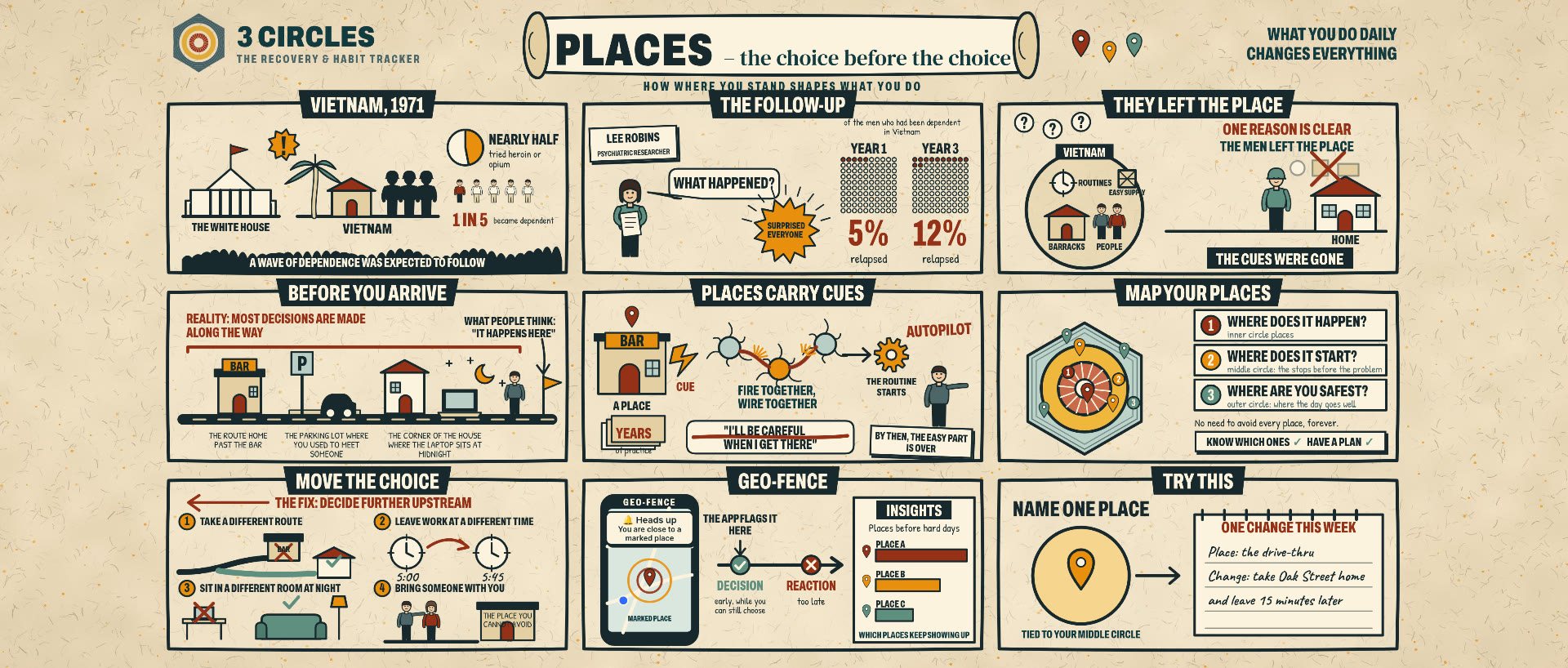
In 1971, the White House received news that alarmed it. Heroin use among American soldiers in Vietnam was widespread. Nearly half of enlisted men had tried heroin or opium, and about one in five had become dependent on it. Officials expected a wave of dependence to follow the troops home.
A psychiatric researcher named Lee Robins was asked to track what happened. Her results surprised almost everyone. In the first year after coming home, only about 5 percent of the men who had been dependent in Vietnam relapsed. After three years, the figure was about 12 percent.
Researchers still debate every reason behind those numbers. One reason is clear. The men had left the place. The barracks, the routines, the people and the easy supply stayed in Vietnam. At home, the cues were gone. Today what that would look like is called "ritualization".
Decisions start before you arrive
Most people think a decision happens at the moment of choice. Marketers would love for that to be the case because they could spend a heck of a lot less money. In reality, most decisions are made by the time you are standing somewhere. The route home past the bar. The parking lot where you used to meet someone. The corner of the house where the laptop sits at midnight.
Places carry cues. Neurons that fire together, wire together. These cues set off a routine before you have even finished thinking. In less than a blink of an eye. For years, and by that we mean years, we have trained the mind to get to this state of autopilot. It will take work to undo this reality. That is why "I'll be careful when I get there" rarely works. By the time you get there, the easy part is over.
Many decisions are made by the time you are standing somewhere.
Map your places
Start with a plain list. Three questions cover most of it.
- Where does it happen? The specific places tied to your inner circle behaviors.
- Where does it start? The places tied to your middle circle: the stops that come before the problem.
- Where are you safest? The places tied to your outer circle, where the day goes well.
You do not need to avoid every place on the first list forever. For some, they will. But maybe that's not you. You need to know which ones they are, and you need a plan before you get close.
Move the choice earlier
The fix is to make the decision further upstream. Take a different route. Change the time you leave work. Sit in a different room at night. Bring someone with you to the place you cannot avoid. It will require intentionality to unwire what was so delicately wired for so long.
Geo-Fence in 3 Circles is built for this. You mark the places tied to your patterns. As you get close to one, the app can flag it, notify you, so the decision happens early, while it is still a decision and not a reaction. Over time, Insights shows which places keep showing up before hard days.
Sources: STAT: lessons from Lee Robins' Vietnam study · Hall et al., Addiction (2017): Lee Robins' studies of heroin use among US Vietnam veterans